Friday, January 30, 2015

Rajib's Holud


On December 26, the morning of Rajib’s holud, I woke up very hoarse.  The weather in Dhaka was more damp and chillier than I imagined it would be.  That, and the fact that I was talking to everyone the day before, must have caught up with me.  I felt fine, but I had no voice whatsoever.  One Bangladeshi friend later observed, "Oh, you have a broken throat,” which I was told is the literal English translation for what is said in Bangla.  My broken throat and I still went to Rajib’s holud, although I sounded like a whispery frog.

 Early that day, Shaz left to get her henna done for the wedding day.  Her henna was applied to both hands from every fingertip to the elbow, and all the way around the arm.  It took over six hours to apply!  (She knew enough not to smear any.)

Rajib’s holud was held in the evening.  On this occasion, I dressed in a brown sari and Jim wore a new ivory Punjabi that he had bought earlier in the week.  As the bride-to-be traditionally does not attend the groom’s holud, everyone except Shaz left the flat around 5:00.  

With marigold petals in my hair
Rajib’s holud was also held in a beautiful venue.   This time, her family brought all the dalas for him and his family.  When we arrived at his holud, I found out that I was to go first.  I am to carry the most important dala --- the one for Rajib.  This one contains the clothes he is to change into right away and wear at his holud. 

Presentation of dalas
Jim, cousin Alvee, and Mark
We go up the stairs – and as we enter, marigold petals rain all around us and horns blow.  It is quite the greeting!  My eyes search desperately for Rajib, and can’t find him.  In the process, I hold up everyone behind me on the stairs.  Finally, someone takes his dala from me, I step aside, and the rest of the family/friends proceed in. 


John's cotton candy beard.  
Again, there is much merriment!  We are seated at a side table, and showered with sweets like cotton candy, honey-like spiral treats, and chai tea.  John makes quick use of his cotton candy! 
Apparently, he wanted to look more like Jim. 

When the dancing begins - starring Rajib’s sister and other family and friends, Jim and I are led to the front row, and get the privilege of sitting right next to Rajib. 
 
Rajib and Jim
(photobombed by Elizabeth)
Rajib also surprises us with a dance.  (Shaz later says she’s really impressed when she heard that.)   

Wonderful dancers!

Rajib joins in


I loved this little girl's sari

Mark and Beth are watched over by Alvee's mother on left,
and Rajib's mother on right.


We eat a wonderful dinner.  Even with all the tables, the people attending number in the high hundreds – so we eat in shifts.  When a table is done, they stand and new plates are set.

The last surprise happens late in the evening when Shazreh shows up – and joins in the fun.  Apparently, she didn’t like staying at home by herself!


Rajib's turmeric ceremony, with Nahar and Salehuddin


Shazreh’s Gaye Holud

Colorful people
A bride’s gaye holud is part bachelorette party, part bridal shower.  Family members and friends from both sides are invited.  In Shaz’ case, about 700 people were invited to her holud on December 25.  

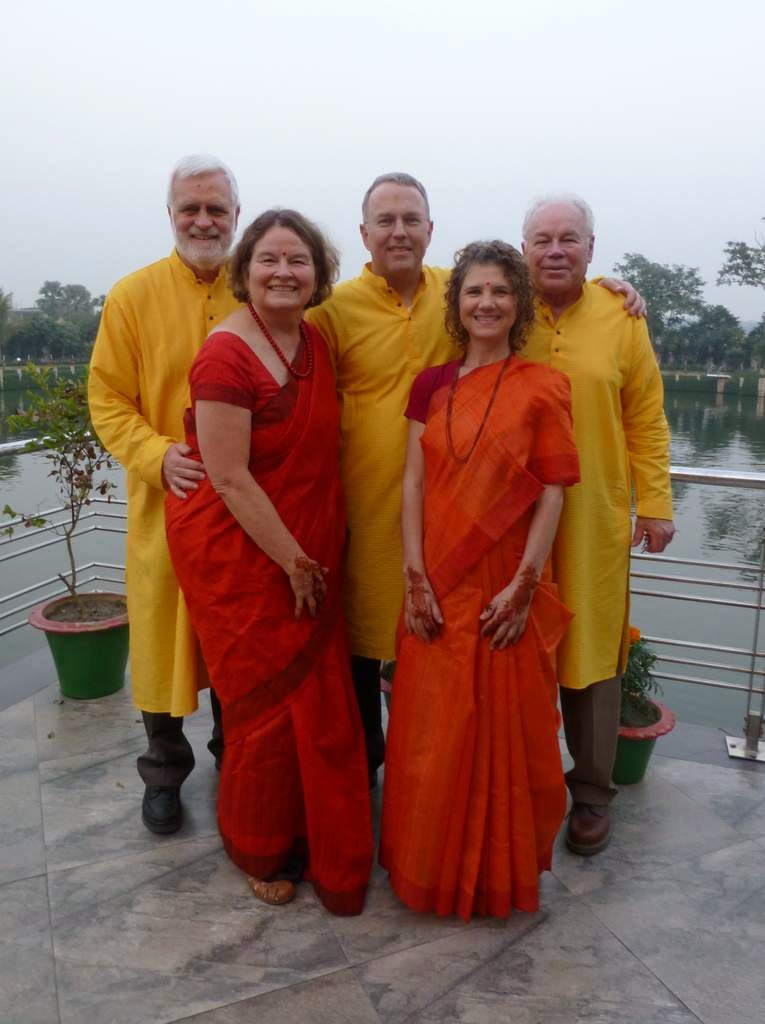
The day started at Salehuddin and Nahar’s flat.  The women dressed together in the bedrooms, where Nahar wrapped Sophie, Elizabeth and me into our saris.  We put on our bangles (bracelets), and a bindi was placed between our eyebrows.  Mine is quite jeweled, and I love it!  All of Shaz’ family is dressed in shades of mustard yellow, red or orange.   We are colorful people!

The beautiful venue


We ride out together on a small bus to the venue, a beautiful setting along a small lake.  The holud has a carnival or county fair atmosphere – with a small, colorfully painted ferris-wheel (considered very traditional at a holud), fresh coconuts being tapped right there for juice, food stands supplying cotton candy and other favorite snacks, a small band of roving musicians, and ... a henna station!


Irina, Ryan, and Imaani at the festivities!

Eating snacks


We three – Beth, Sophie and I - are the first in line to get henna applied.   Intricate designs are drawn on our wrists, hands and fingers, using wet, raised (almost bubbly) black ink.  We rapidly find out that you can’t touch anything, or it smears.  For the most part, our drawings are still intact when - after about an hour - the black ink dries up and flakes off, leaving behind red henna designs.  Folklore says that the redder the henna is, the more your mother-in-law likes you.  (Mine should have been crimson red!)
The henna artists
We greet members of Rajib’s family as they arrive.  Jim and I already know Alvee, a cousin of his, who attends St. John’s.  We are honored to meet Alvee’s entire family.  And, we meet Rajib’s father, mother, and siblings. 

After all the guests have arrived, our attention is drawn to the lake.  Shazreh is coming, gliding in on a white boat with a large swan head.  The musicians double the sound of their music, and she walks up the steps to applause. 


With her arrival, all the guests are seated at tables and the meal is served.  While we eat, we are entertained with dancing by family and friends of Shazreh.  Watching them, we get more nervous, as we know that we will be dancing soon (and we hate to follow these great dancers).  Finally, it is our turn.  We dance in front of these hundreds of people – to rave reviews!
A gift from our hearts

(If you would like to see our dance sensation, Jim has posted it to YouTube at: https://www.youtube.com/watch?v=u62z_PLhmPg&feature=youtu.be) Afterward, many people approach us to compliment us on our dance.  We’re sure they appreciated our efforts, if not our skills!  They recognized that it was a gift from our hearts, and we received "many thanks" back.  As one example, two different families ask us to come to their homes for meals while we are in Dhaka.  What an honor to be asked!
Bride's surprise dance


But, the star dancer of the day is Shazreh.  It is not customary for the bride to dance at her own gaye holud, but Shazreh is no ordinary bride.  During the final dance, she suddenly gets up from her table and joins the fun.  Beaming with a mischievous smile, she is the clearly the best dancer of the day.

Mark gets turmeric


After the meal, Shaz is seated on a dais up front, and family members and guests come up to wish her well and apply turmeric paste.  The turmeric is on a large tray, and a small amount is applied by the guest to Shaz’s forehead or hands. Sometimes, in a sign of allegiance – the guest applies some turmeric to her own face - or of a loved one's!  
All of us with the bride and groom.
A wonderful time was had by all.


City tour of Dhaka


The day that Leon arrived (December 24th), he went to bed due to his jet lag.  The rest of us were treated to a tour of Dhaka, a gift from a friend of Salehuddin’s.  His name was Iqbal Rahman, and he was "the best guide" (or was it "best guy") ever.  We didn’t get to too many places, as the traffic in Dhaka moved at a crawl – but we thoroughly enjoyed what we did see.  

The first stop was Sangshad Bhaban, the Parliament building.  We only viewed the building from its outside – which was striking, sitting as it does inside a designed lake.   Jewish-American Louis Kahn designed it, incorporating Bangladeshi and Muslim architectural styles.  We were told a great documentary film about him exists, called “My Architect.”  (We hope to find and watch it sometime.)

While at the Parliament, we first encountered what would become a commonplace thing throughout Bangladesh and Myanmar --- “We were rock stars.”   Random people – from young to old, male and female – would come up and ask if they could take a picture with us.  Of course, we would always say yes.  Here is one man who picked out Jim for a picture “because they looked so much alike.” 
Jim and his "look-alike"

At the tomb of Bibi Pari


Our second stop was the Lalbagh Fort, a precursor to the Taj Mahal story.  A palace fortress from the Mughal time, it was begun in the late 1670s when Prince Azam, son of the reigning Mughal Emperor was betrothed to Bibi Pari, the daughter of Bengal’s governor.  But Bibi Pari died, and the palace's construction ended.  Now, it is her tomb. 


The highlight of the city tour for most of us, especially Mark, was the visit to old town – and a 30-minute rickshaw ride.  You can’t really appreciate the Dhaka traffic until you are in it - either walking or riding in a bicycle rickshaw or CNG (three-wheeled motorcycle with caged back seat).  We all took off in different rickshaws: John and Sophie, Beth and I, and Jim and Mark.

John and Sophie
Jim will never forgive me for accidentally deleting the video he made of his ride.  So, let me try to describe the traffic in words.  Any traffic lights or painted lanes that may exist are for decoration only.  Cars, trucks, buses, rickshaws, CNGs, buses, bicycles, and any pedestrians crossing the road are all crammed together.  Roads that were meant for two lanes have at least five lanes of traffic.  The city buses are all old; none have working tail lights or turn signals.  Their sides are so scraped, taped, and scraped again that you have no idea of the original color.
Photo of only the rickshaw traffic

This is how Jim described the traffic in an email to our kids:  Dhaka was wild!  Think of crowds milling in a stadium or concert and how it is everyone for themselves - pushing and slipping into any little cracks to make progress to where they want to go.  Now put each of those people in a car, truck, motorcycle, tuktuk (3 wheel taxi), or bicycle and you get the idea.  If you are able to stick the nose of your vehicle into a little gap between 2 cars, you have now claimed the right to that space and the one car will have to let you in - unless they can slide over slightly and get around you and get an advantage for themselves.  It looks completely chaotic and you are sure you are going to be in a dozen accidents a day, but we were in none.  As our guide Iqbal says, “Out of chaos comes order,” and somehow it all works. 

My biggest point of pride, though, was that while in Dhaka I learned to cross the street!  At first, my tactic was to find a local and, when they decided to cross the street, I would walk exactly beside that person with the same stride.  They sometimes gave me a funny look, but most of the time they started to lead the way with a smile.  That worked great for some time.  Then, I started crossing as if I was the local.   I had arrived!

Here are a few local scenes/faces:
Street Vendors


Saving the prettiest to last...


Tuesday, January 27, 2015

Wedding Preparations


I should mention how we know Shazreh, the bride.  We met Shaz in 2008 in China!  If this sounds familiar, it is.  It is the same story as to how we met Kunduz whose wedding in Kyrgyzstan we attended in August. (See jckyrgyzmoscow.blogspot.com)   

We met Shaz when she came running out the first night we arrived.  Americans!”  She said, “Finally - Someone I can talk to!”  Shaz was 17, in China alone enrolled in a Chinese language immersion program, and terribly homesick for Bangladesh.  She had spent one year of high school in the states so we represented something familiar to her.  Shaz rapidly became friends with our students and us.  Throughout that semester, Jim tried to convince both Kunduz and Shaz to apply to St. Ben’s – which Shazreh did.  While attending her four years there, Shaz would come to our house for school holidays, such as Thanksgiving.  We grew very close.  Shaz is now a CPA, and works for Price Waterhouse in Texas. 

The other person to introduce is the groom – Rajib.  Shaz met him the first week she was in Minnesota.  (Who knew there was an active Bangla contingent alive and well in St. Cloud/the Cities?)  On their first date, they went to a movie – Love Happens.    When hearing about this, her friends in Dhaka quickly lengthened the name: “Love happens … in Minnesota.”

The days leading up to their wedding sped by …

            Pursuing the perfect pagri.  One whole afternoon was spent on Elephant Road in Dhaka in order to find the perfect wedding turban, called a pagri, for Rajib to wear on the wedding day.  Elephant Road is known for its rows of pet stores ... and wedding shops!   Many of them offered turbans for sale.  At first glance, they looked the same, but after several hours the complexity of the task grew:  Did you want a fan on top or not?  A gemstone?  Should the turban’s sides be flat or puffed?  How many colors should it have: one, two, or more?   After much consideration and consultation, the purchase is complete.  (Maybe the live model helped.)  Success!


            Wrapping the dalas.   Traditionally in Bangladesh, the families of both the bride and groom prepare gifts for their new daughter- or son-in-law, and their family members.   The new bride or groom is to be given everything as if they were starting afresh – from socks to shaving cream, suits to shoes, shirts to new punjabis.

When we were still in the States, Shaz asked if I could help wrap some presents.  “Sure,” I said, thinking that I could handle that.   But, this was no ordinary wrapping.  Called dalas, these presents are given publicly, and the presentation is very important.  Boxes of gold, silver, or deep purple act as the base.  Then, you arrange the gifts just so, before adorning them with flowers, bubbles, ribbons and bows – and covering them with cellophane.   I must say we did a pretty good job.   What do you think?

            Going to the tailor.  During these few days, I also went to get measured for my blouse and petticoat.  This is no ordinary blouse, but the blouse to wear under my sari to the wedding. It needs to be fitted to the shape of your upper torso and upper arms just right; most end right below the bra line, but I wanted mine a bit longer. This is my first time interacting with a personal tailor, discussing sleeve length and scoop or square necklines, all without a word of common language passing between us.  

            Welcoming reinforcements.  Shaz also “mentioned” to Jim and me that we would be joining in the family dances at the wedding.  What she neglected to say was that she was hoping we would do a dance by ourselves at the large celebration.  One evening, she and Irina tried to teach Jim and me a dance to a well-known folksong.  The only way I could remember the moves was to give them names.  On my cheat sheet was written, “wings, stop sign, window washer, scoops, pointing at the crowd, the thinker, baby cradle, window washer.”  Luckily for Shaz, reinforcements – in the form of better dancers - appeared.   Family members of ours arrived: Mark, Elizabeth, and Leon, and we all met two CSB/SJU college friends of Shaz - Sophie and John from Minnesota.  Talk about delightful!  They became our instant friends.  So, the six of us became the dancers. (Leon wasn’t feeling well.)  Now, the only thing that shook our confidence was that every time we tried to sneak in a rehearsal at Shaz’ parents, anyone within eyesight started giggling! 

But, I shouldn’t talk so much about what we were doing leading up to the wedding.  The overall STAR of the wedding preparations was Nahar, Shaz’ Mom.  She had planned so much --- taking care of not only several main events but all the details.  She had purchased matching punjabis for the men in Shaz’ family (including John, Jim, Mark, and Leon), found saris for us women, bought all the presents and wrapping supplies for the dalas, lined up flowers and microphones ---- AND planned all the meals for us to eat every day at her home.   If Nahar hadn’t just received her doctorate in human resource management, I would be first in line to promote her future career as a wedding planner!